Ever wondered why some people stay calm under pressure while others struggle with stress and challenges? Your D27 chart in Vedic astrology is not just about personality,it reveals your inner strength, emotional resilience, and psychological makeup. By analyzing this chart, you can uncover hidden strengths, identify vulnerabilities, and understand how you cope with life’s pressures. Aligning with these insights can help you build mental stamina, emotional balance, and personal growth.
Why do some people stay strong in challenges while others break? The answer lies in the D27 chart. This chart clearly shows a person’s inner strength, weaknesses, and stamina, making it one of the most insightful yet least used tools in Vedic astrology.
Want to know what your D27 chart says about your inner strength? Get your detailed reading now!
What is the meaning of the D27 chart?
The D27 chart, also known as the Saptavimshamsa chart, represents a person’s inner strength, resilience, tolerance, and psychological stability. It reveals how strong you are from within, how you handle pressure, and what hidden fears or weaknesses influence your emotional responses. Unlike other charts that show external events, the D27 focuses entirely on your mental, emotional, and internal power.
What is the D27 chart in Vedic astrology?
In Vedic astrology, the D27 chart is one of the Shodasha Vargas (16 divisional charts).
It divides the zodiac into 27 equal parts, corresponding to the 27 Nakshatras, which is why it is also called the Nakshatra Vimsamsa,Saptavimshamsa chart.
This chart is used to analyze a native’s capacity to face challenges, their level of endurance, and their ability to resist negativity, obstacles, and emotional turbulence.
House by house guide to the D27 chart
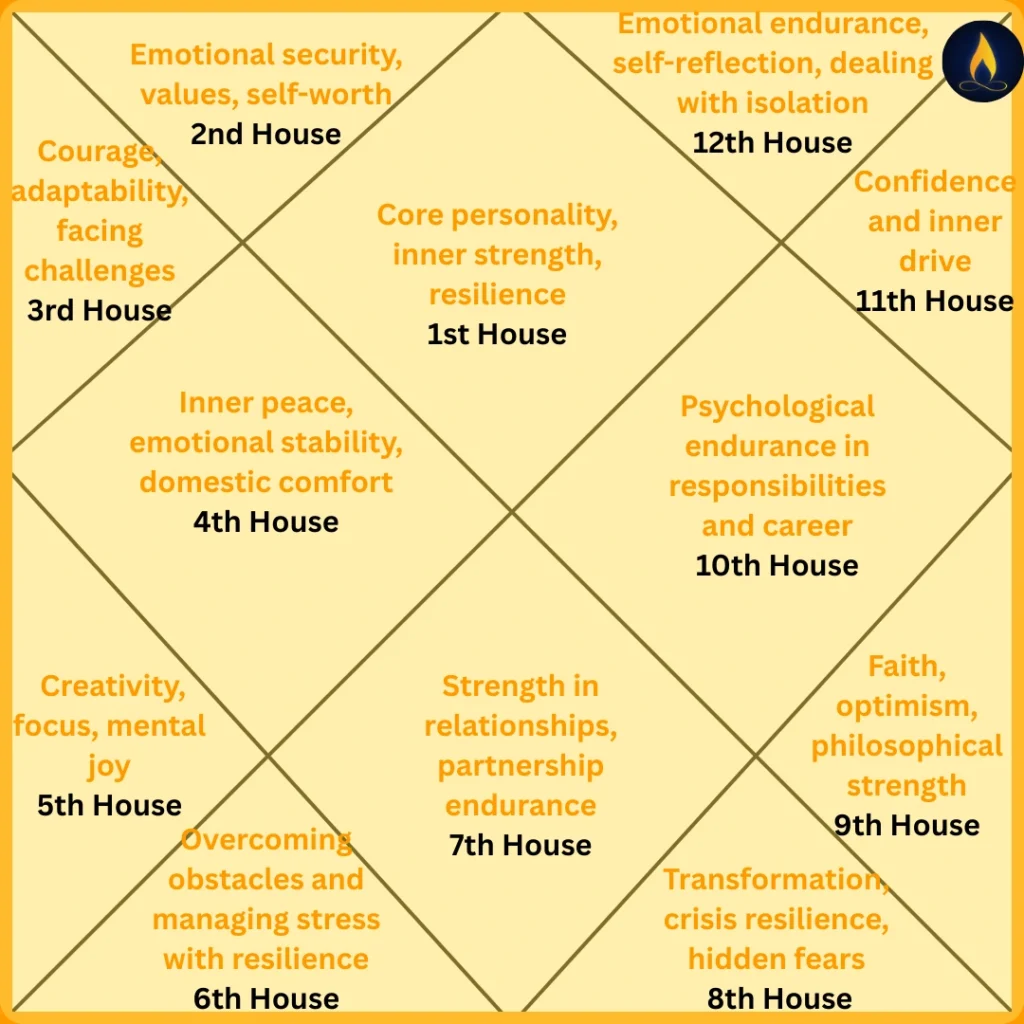
How to calculate Saptavimshamsa(D27) chart chart?
Calculating the Saptavimshamsa chart is an advanced process in Vedic astrology. It reveals inner strength, emotional resilience, and psychological stability, going deeper than the D1 (natal) or D9 (Navamsa) charts.
Start with your D1 (Rashi) chart
The D1 chart, or Lagna chart, shows the exact planetary positions at the time of birth. To calculate Saptavimshamsa chart, you first need the precise longitude of each planet in the zodiac signs.
Example: Mars = 10° Taurus, Venus = 23° Gemini, etc.
Divide each zodiac sign into 27 parts
Each zodiac sign spans 30°. For D27, divide 30° by 27, giving 1°6′40″ per segment. This small division allows a very detailed view of each planet’s influence.
Locate each planet in its segment
Check the exact degree of a planet in its sign, then identify which of the 27 segments it falls into.
Map planets onto the D27 chart
Each segment corresponds to a sign in the Saptavimshamsa chart based on a specific sequence. Place each planet in its corresponding segment to build the D27 chart.
Interpret the D27 chart
The Saptavimshamsa chart reveals your inner strength, emotional resilience, and psychological foundation. It highlights not just external events but your core mental and emotional tendencies, helping you understand how you respond to life’s challenges.
If you want to know about other divisional chart, click here
How to read D27 chart?
Reading the Saptavimshamsa chart is different from reading D1 (life events) or D9 (marriage/spiritual potential). D27 is all about inner strength, psychological resilience, and emotional stability. Here’s a clear guide:
Understand the Focus of D27
- Purpose: Shows your internal strength, endurance, and mental/emotional foundation.
- Not for: Predicting daily events, career, or relationships directly.
- Who uses it: Astrologers use it to assess how a person handles challenges, recovers from setbacks, and copes mentally/emotionally.
Key Points to Observe
Lagna (Ascendant) in D27
- Indicates your core personality and inner mental energy.
- Strong Lagna and benefic planets here suggest resilience and inner stability.
Strength of Planets
- Strong planets (own sign, exalted, friendly aspects) indicate inner resources.
- Weak or afflicted planets show areas where emotional or psychological support is needed.
Look at Planetary Combinations
- Benefic influence on Lagna: Good emotional and mental foundation.
- Malefic influence on Lagna or Moon: Challenges in emotional resilience; lessons come through hardship.
- Conjunctions or aspects: Indicate specific mental/emotional tendencies (e.g., a strong Mars-Saturn influence shows disciplined courage, but may also indicate stress under pressure).
General Interpretation
- Strong D27 chart: Calm, focused, resilient, capable of handling crises.
- Weak D27 chart: Sensitive, easily stressed, emotional reactions dominate.
Planetary transits in D27: Rarely used for timing events; mainly highlight periods of internal growth or emotional challenge.
Tips for Beginners
- Focus first on Lagna, Moon, and Mars positions for resilience.
- Compare with D1 and D9 to see if internal strength matches outer achievements.
- Always consider planet strength and aspects to understand mental/emotional tendencies fully.
Significance of D27 chart
The Saptavimshamsa chart is highly significant in Vedic astrology, but it’s often overlooked compared to D1 (Rashi) or D9 (Navamsa). Here’s a clear breakdown of its significance:
Reveals Inner Strength and Resilience
- Saptavimshamsa shows your mental and emotional foundation, not just external life events.
- It indicates how you handle stress, setbacks, and crises.
- Strong Saptavimshamsa placements suggest a calm, determined, and psychologically stable personality.
Assesses Psychological Endurance
- Saturn, Mars, Moon, and Lagna in Saptavimshamsa reveal patience, courage, and emotional endurance.
- It tells you where you might face internal struggles and where you have hidden strengths.
Supports Self-Mastery and Personal Growth
- By analyzing Saptavimshamsa, you can understand patterns of mental resilience and areas that require inner growth.
- Helps in cultivating self-discipline, emotional intelligence, and coping mechanisms.
Guides Spiritual and Emotional Development
- Saptavimshamsa highlights the psychological readiness for spiritual practices or self-improvement.
- It shows how deeply you can endure challenges on the path of inner transformation.
Complements Other Charts
- While D1 shows life events and D9 shows relationships/marriage/spiritual potential, D27 is the chart of inner power.
- A strong D27 often explains why some people succeed despite external obstacles, or why some struggle internally even if outer life seems fine.
Prediction of D27 chart
Inner Strength and Resilience
- Strong Lagna and benefic planets in Saptavimshamsa chart → You have mental stability, courage, and endurance in life.
- Weak or afflicted Lagna/Moon → You may face emotional stress or internal struggles, even if outward life seems smooth.
Emotional and Psychological Tendencies
- Moon’s position → Shows emotional resilience and how you handle stress.
- Mars and Saturn → Indicate courage, patience, and ability to face challenges.
Coping with Challenges
- Saptavimshamsa reveals how you respond to setbacks.
- Strong chart → You recover quickly, stay composed, and persist under pressure.
- Weak chart → You may feel overwhelmed, anxious, or indecisive when facing difficulties.
Support for Personal Growth
- Saptavimshamsa highlights areas where self-discipline, patience, or emotional strength needs improvement.
- It also shows innate talents for handling pressure and adversity, which can guide life decisions.
Key Takeaways
- Purpose: Reveals a person’s inner strength, emotional resilience, and psychological stability, showing how they handle stress, challenges, and setbacks, with a focus on internal power rather than external even
- Divisional Chart: The D27 is one of the Shodasha Vargas (16 divisional charts), dividing each zodiac sign into 27 equal parts corresponding to the Nakshatras, and is also called the Nakshatra Vimsamsa or Saptavimshamsa chart.
- Key Houses: In the D27 chart, Lagna shows core personality, Moon emotional endurance, Mars courage, Saturn patience, Jupiter optimism, Sun psychological willpower, and Venus & Mercury emotional intelligence and adaptability.
- Shows: The D27 chart reveals mental and emotional resilience, hidden strengths and weaknesses, and the capacity to cope with challenges and pressure.
Get your personalized D27 chart Reading– Book your consultation right here
Don’t miss our latest updates—follow us on Instagram and Tiktok
FAQs
How is weakness shown in D27?
Weak or afflicted houses, especially 1st, 4th, 8th, and 12th, indicate areas of emotional vulnerability or lack of resilience.
What is the use of D27 chart?
The D27 chart (Saptavimshamsa) reveals a person’s inner strength, emotional resilience, and how they handle stress or challenges. It highlights hidden strengths and weaknesses, guiding personal growth and coping strategies.
What does the D27 chart reveal about a person?
The D27 chart (Saptavimshamsa) reveals a person’s inner strength, emotional resilience, and psychological makeup, showing how they handle stress and challenges highlighting hidden strengths and vulnerabilities rather than external events.
How is D27 different from D1 (birth chart) and D9 (Navamsa)?
The D27 chart differs from D1 and D9 by focusing on inner strength, emotional resilience, and stress-handling, revealing a person’s psychological and mental coping abilities rather than external events.
Why Is the D27 Chart Important for Mental Health?
The D27 chart is important for mental health as it reveals a person’s emotional resilience, strengths, and vulnerabilities, helping them understand stress responses and build emotional stability.