Curious about your hidden fears, struggles, emotional wounds, or the patterns of misfortune you carry from past lives?
The D30 chart (Trimshamsha) is one of the most important yet deeply misunderstood divisional charts in Vedic astrology. While your main birth chart (D1) shows what happens in life, the D30 chart reveals why it happens, especially the root cause of suffering, obstacles, mental/emotional pain, and past-life karmas that shape your destiny.
Unlike positive charts such as D9 or D24, the D30 exposes the darker side of karma, the challenges you must overcome, the emotional patterns you carry, and the karmic debts that manifest through fear, illness, accidents, betrayal, or personal struggles.
Keep reading to discover how your D30 Chart Meaning reveals your hidden wounds, karmic lessons, and the path toward transformation.
What Is the D30 Chart in Vedic Astrology?
The D30 Chart, also known as the Trimshamsha, is a divisional chart described in classical astrology texts like Brihat Parashara Hora Shastra to analyze inauspicious results, suffering, and past-life negative karma (paap karma). It is formed by dividing each zodiac sign of the birth chart into 30 equal parts of 1° each, with different planetary rulerships for odd and even signs. The chart reveals the hidden causes of misfortune, disease, accidents, mental distress, and repeated life obstacles that may not be fully visible in the main birth chart. In practice, it is mainly used to understand why negative events occur and which planet is responsible for karmic suffering during its dasha.
Significance of D30 Chart
1. Past-Life Karma (Paap Karma)
Unresolved actions from past births that show up as obstacles and repeating life patterns.
2. Emotional Pain & Inner Wounds
Fear, trauma, guilt, anxiety, and deep-rooted insecurities.
3. Hidden Enemies & Negative People
People who cause stress, deceit, or unseen harm.
4. Accidents & Sudden Harm
Injuries, mishaps, unexpected setbacks.
5. Illness & Weak Health Periods
The type of sicknesses a person may face due to karmic imbalance.
6. Misfortune & Bad Timing
When and how difficulties strike in life.
7. Karmic Lessons & Healing

What you must learn and transform to overcome suffering.
In essence, the Trimshamsha chart exposes your shadow self, the part of your destiny that must be purified.
Why the D30 Chart Is Crucial
You cannot fully understand a person’s life struggles without analyzing this chart.
It shows:
- Why certain problems keep repeating
- Why a person suffers emotionally
- Why setbacks happen suddenly
- Why certain people betray or hurt you
- Why fear, anger, or negativity rises
- Why health or mental issues occur
While the D1 chart shows physical events, D30 shows the karma behind those events.
This makes it one of the most powerful predictive tools for understanding negative life events and emotional healing.
How the D30 Chart Is Calculated
The D30 Chart (Trimshamsha) is calculated by dividing each 30° zodiac sign of the birth chart into 30 equal parts of 1° each, as described in Brihat Parashara Hora Shastra. The allocation of these 1-degree divisions differs for odd and even signs, with each Trimshamsha being ruled by specific planets. Based on the exact degree of a planet in the birth chart (D1), its corresponding Trimshamsha sign is determined and placed in the D30 chart. This precise division reveals the planet’s karmic role in suffering, obstacles, and negative life experiences.
Get Your Personalized D30 Chart Reading → Book Your Consultation Now
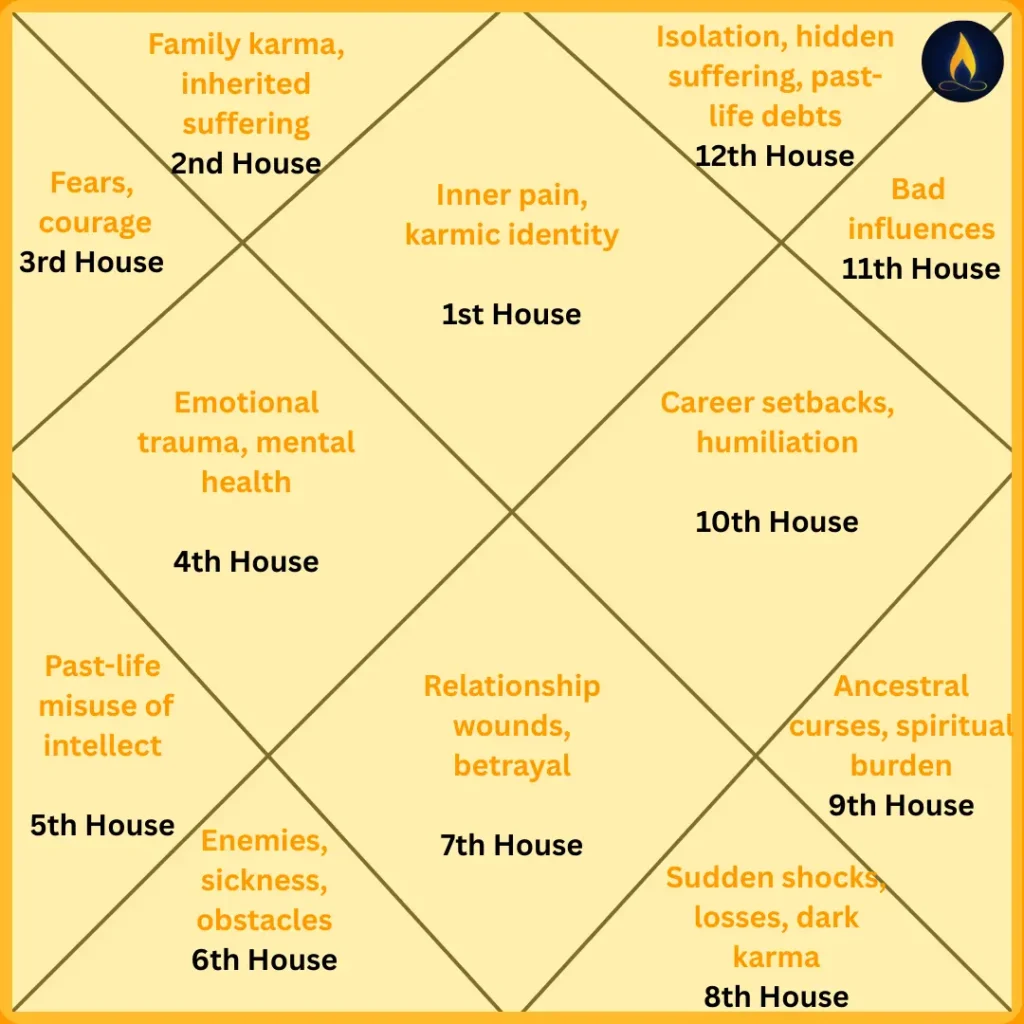
All 12 Houses of D30 Chart (Trimshamsha House Meanings)
How to Read D30 Chart (Step-by-Step Guide)
Generate an accurate D30 chart
The D30 chart is extremely sensitive, and even a one-minute difference in birth time can change its results completely. Therefore, exact birth date, time, and place are absolutely essential for reliable analysis.
Check the D30 Lagna (Ascendant) first
The D30 Lagna represents the core karmic wound and the main theme of suffering in a person’s life. For example, Aries Lagna shows anger-driven pain, Libra Lagna shows relationship wounds and betrayal, and Pisces Lagna indicates emotional trauma and abandonment.
This will make more sense once you know your Lagna — read it here
Analyze malefic planets deeply
Special attention must be given to Saturn, Mars, Rahu, Ketu, and an afflicted Sun because they are the primary carriers of suffering in the D30 chart. Their sign, house, and aspects reveal the exact source and nature of struggles.
Compare the D30 chart with the birth chart (D1)
If a planet is strong in D1 but weak in D30, it indicates hidden suffering despite outer success. If a planet is weak in D1 but strong in D30, it shows silent karmic protection during difficult times.
Check doshas, aspects, and planetary dignity
Combust, debilitated, or heavily afflicted planets in this chart represent karmic weakness and vulnerability to suffering. Benefic aspects and dignity, on the other hand, reduce the intensity of negative results.
Study the 6th, 8th, and 12th houses in D30
These houses represent enemies, disease, sudden loss, fear, isolation, and repeated obstacles. Strong afflictions here directly point to periods of intense struggle and transformation.
Use Dasha and transits for timing
Major setbacks usually occur during the dasha of the D30 Lagna lord or planets placed in the 6th, 8th, or 12th houses. Rahu and Ketu periods are especially powerful in triggering karmic events shown in the D30 chart.
Common Myths About the D30 Chart
“This chart means bad luck only.”
Not true — it also shows how to overcome suffering.
“Only malefics matter.”
All planets matter; benefics show protection.
“The chart activates only when problems happen.”
It works throughout life but becomes stronger in difficult dashas.
Key Takeway
Purpose: Karma, suffering, emotional wounds, negative events
Divisional Chart: 30th division
Key Planets: Saturn, Mars, Rahu, Ketu
Key Houses: 6th, 8th, 12th (suffering)
Shows: Past-life karma, misfortune, fears, hidden enemies
Ideal for: Healing, karmic insight, emotional transformation
Unlock the secrets of your past-life karma and hidden wounds, Get Your Personalized D30 Chart Reading → Book Your Consultation Now
Don’t miss our latest updates—follow us on Instagram and TikTok!
FAQs
What is the D30 chart in Vedic astrology?
The D30 chart, also known as the Trimshamsha, reveals hidden weaknesses, misfortunes, and karmic challenges in a person’s life. It helps identify the subtle negative influences that are not easily visible in the main birth chart.
Can the D30 chart help in identifying remedies or protection?
Yes, the D30 chart guides astrologers toward specific remedies by showing the source of negative energies. It helps suggest spiritual practices, mantras, and lifestyle changes that can reduce obstacles and bring balance.
Why is the D30 chart important for understanding obstacles?
The D30 chart shows the root cause of recurring problems, sudden losses, and emotional or spiritual disturbances. It allows astrologers to pinpoint karmic patterns that need healing or correction.
How do astrologers interpret the D30 chart?
Astrologers examine the sign divisions, planetary placements, and the dominance of Mars or Saturn to understand the intensity of challenges. They also assess aspects and conjunctions to reveal how hidden issues manifest in real life.
Which planets affect the D30 chart the most?
Malefics like Saturn, Mars, Rahu, and Ketu have a strong impact on the D30 chart because they influence suffering and adversity. Their placement shows where your deepest lessons and internal struggles originate.