Before the dawn of apps, charts, or even telescopes, one sage envisioned the entire cosmic dance of karma, time, and planetary influence. That visionary was Rishi Parashara the father of Vedic Astrology. His insights weren’t just rules and formulas; they were windows into the soul’s journey through lifetimes.
If you’ve ever explored your Kundali, consulted your Dasha periods, or wondered why you were born at a particular moment you’re walking a path he lit thousands of years ago.
Let’s step into the legend, legacy, and life of this monumental sage.
Introduction to Rishi Parashara
Rishi Parashara, revered as a Maharishi (great sage), stands among the most influential figures in the spiritual and intellectual legacy of the ancient Sanatan tradition. He lived during the Dvapara Yuga an age steeped in sacred wisdom, where divine knowledge was transmitted through oral tradition from guru to disciple.
He is most renowned as:
- The author of Bṛhat Parāśara Horā Śāstra (BPHS) – the foundational text of Jyotish Shastra (Vedic Astrology)
- The father of Ved Vyasa, compiler of the Mahabharata and the Vedas
- A bridge between the mystical realms and structured knowledge
His teachings blend philosophy, cosmology, and predictive science in a way that still guides modern astrology, centuries later.
Maharishi Parashara and His Contribution to Vedic Astrology
The Roots of Jyotish Shastra
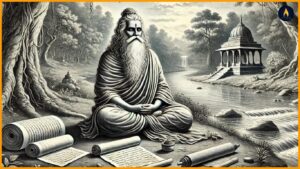
Maharishi Parashara wasn’t just a scholar; he was a seer. He envisioned astrology as a divine light (Jyoti) that reveals karmic patterns and spiritual purpose.
He taught that the stars and planets don’t cause events, they reflect the karmic blueprint of each soul. His approach blends spiritual insight with empirical observations, making Jyotisha not just a tool for prediction, but a guide for inner growth.
Bṛhat Parāśara Horā Śāstra (BPHS) – The Soul of Jyotisha
BPHS is the crown jewel of Rishi Parashara’s work a foundational text of Vedic Astrology that has been preserved and passed down by sages and astrologers for thousands of years.
Key Elements in BPHS:
- Vimshottari Dasha System
Parashara introduced this powerful planetary time cycle system that predicts the unfolding of karma over time. It’s the most widely used Dasha system in astrology today. - Graha (Planetary) Karakatwas
He detailed the meanings and roles of each planet how they influence physical, emotional, spiritual, and material aspects of life. - Bhava Analysis (House Analysis)
BPHS offers deep insight into the twelve houses, their lords, and interconnections, laying the foundation of natal chart interpretation. - Yogas and Raja Yogas
Parashara cataloged hundreds of planetary combinations (yogas) that indicate prosperity, spiritual evolution, fame, misfortune, and more. - Karmic Astrology
He emphasized that Jyotisha is not about fatalism. Instead, it is a tool for self-awareness, helping individuals navigate their karmic path with clarity and intention.
Rishi Parashara and Satyavati

Beyond scriptures and science, Rishi Parashara’s story is also steeped in mythology and divine romance.
According to the Mahabharata, Parashara met Satyavati, a fisherwoman of great virtue and charm, while crossing the river Yamuna. Enchanted by her presence, Parashara wished to unite with her. But Satyavati expressed concern about her reputation and the timing.
Parashara, using his yogic powers, enveloped the surroundings in mist, elevated time to a suspended state, and blessed her with:
- Everlasting virginity
- Divine fragrance (Yojanagandha)
- A son who would be a Rishi greater than himself
From this union was born Ved Vyasa, the compiler of the Mahabharata, Puranas, and the Vedas.
This moment wasn’t just myth it symbolized the union of spiritual wisdom and earthly life, giving birth to one of the greatest intellects the world has known.
Rishi Parashara’s Sacred Lineage
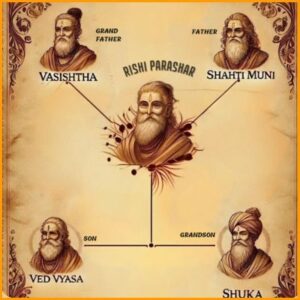
Rishi Parashara’s extraordinary wisdom was shaped by one of the most illustrious lineages of the Sanatan tradition a family of sages whose lives bridged the divine and human realms. Each figure in this lineage played a role in transmitting spiritual knowledge that became the foundation of Vedic philosophy and astrology.
Rishi Vashistha – The Grandfather

Rishi Vashistha, one of the revered Saptarishis, served as the royal preceptor of the Solar Dynasty and composed many hymns in the Rigveda. His ashram was a center of spiritual learning, where seekers came to study the principles of Dharma and self-realization.
He is remembered as the guru of Lord Rama, guiding him not only in statecraft but also in the deeper philosophy of life. Through Vashistha’s guidance, Parashara inherited a devotion to truth and righteousness, values that became the ethical foundation of his astrological teachings.
Rishi Shakti Muni – The Father
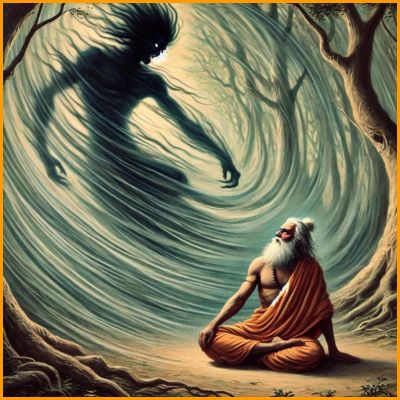
Rishi Shakti, Parashara’s father, was a devoted sage who upheld Dharma with great resolve. His untimely death at the hands of a Rakshasa deeply impacted young Parashara and sparked within him a burning desire to understand destiny and the law of karma.
This tragedy became a turning point, redirecting Parashara from vengeance toward spiritual inquiry. It inspired him to seek answers about rebirth, cosmic justice, and karma questions that eventually shaped his magnum opus, the Bṛhat Parāśara Horā Śāstra.
Ved Vyasa – The Son
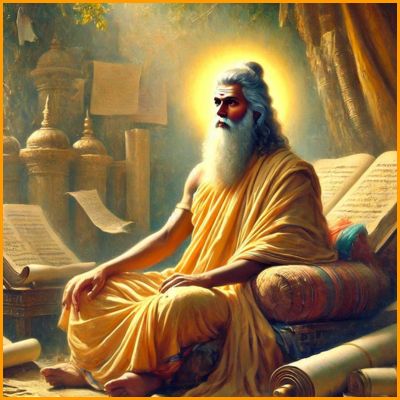
Ved Vyasa, Parashara’s son, is celebrated as the compiler of the Vedas and the author of the Mahabharata, the world’s longest epic. He organized the vast corpus of Vedic knowledge into four parts, ensuring its preservation for future generations.
Through the Mahabharata and the Bhagavad Gita, Vyasa gave humanity some of its greatest spiritual teachings. He carried forward his father’s vision, turning their lineage into a bridge between cosmic wisdom and practical guidance for everyday life.
Together, this lineage shaped not just astrology but all of Vedic literature, dharma, and philosophy.
A Legacy Beyond Time
Maharishi Parashara is not just a name in history. He is the foundation stone of every birth chart ever drawn, every Dasha ever calculated, and every seeker who ever asked, “What is my purpose?”
Key Takeaways:
- Parashara pioneered Vedic Astrology as a system to understand karma, time, and soul’s journey.
- His BPHS text remains the supreme scripture for astrologers worldwide.
- His life blends mythology, romance, and deep spirituality, making him relatable and revered.
- His lineage, from Vashistha to Vyasa, continues to echo through the Mahabharata, Puranas, and every mantra chanted today.
If you’re exploring Jyotish, you’re already walking in the footsteps of Rishi Parashara.
Stay connected for daily insights on Vedic astrology and spiritual guidance by following us on Instagram: @AstroParasar.
Want to know what your own chart says according to Parashara’s timeless system?
Book a consultation with AstroParasar.com and discover the karmic blueprint written in your stars.
Watch our video on Maharishi Parashara: Father of vedic astrology
FAQs
Q1: Why is Rishi Parashara called the Father of Vedic Astrology?
Because he systematized Jyotisha through his text Bṛhat Parāśara Horā Śāstra (BPHS), which is still the core reference for astrologers today.
Q2: What is special about the Vimshottari Dasha system?
It maps out a 120-year planetary cycle, showing not just what events may occur but when they’re likely to unfold.
Q3: How does Parashara’s lineage shape his work?
Coming from the line of Rishi Vashistha and fathering Ved Vyasa, his astrology carries deep moral and spiritual wisdom.
Q4: Is BPHS still used in modern astrology?
Yes, most Vedic astrologers rely on BPHS for chart reading, Dasha analysis, and predictions.
Q5: How can Parashara’s teachings help me?
They reveal your karmic path, guide decision-making, and help align your life with spiritual growth.